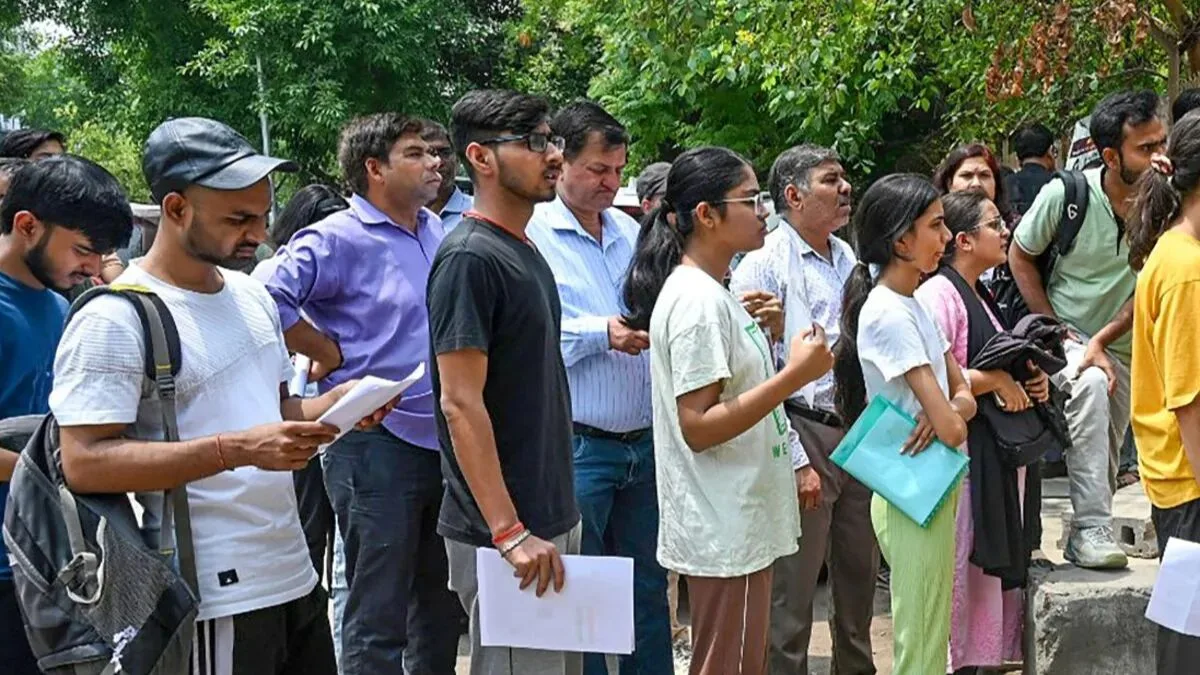
The unprecedented security surrounding the re-conducted NEET-UG examination may ultimately be remembered for what it revealed rather than what it prevented. Metal detectors, biometric verification, signal jammers, surveillance cameras, police deployments and even military-assisted logistics projected an image of a state determined to protect the integrity of a crucial national examination. Yet the very scale of these precautions raises a more uncomfortable question: why has India’s education system reached a point where an entrance test must be conducted like a high-security operation? The answer lies in a growing mismatch between administrative capability and public expectations.
Competitive examinations have become among the most consequential institutions in modern India. For millions of young people, especially those from middle-class and lower-middle-class families, examinations are not merely assessments of knowledge. They are gateways to economic mobility, professional status and social advancement. In a country where opportunities remain scarce relative to aspirations, faith in the fairness of these gateways is indispensable. That faith has steadily weakened. The recurring pattern is familiar. A major examination is followed by allegations of irregularities. Investigations uncover networks of intermediaries, facilitators and beneficiaries.
Advertisement
Authorities promise reforms. New safeguards are announced. Yet another controversy emerges. The cycle has become so routine that each fresh scandal is no longer viewed as an aberration but as evidence of a structural vulnerability. What makes this particularly troubling is that India’s examination ecosystem has expanded dramatically without a corresponding strengthening of institutional safeguards. The stakes have risen faster than the mechanisms designed to protect integrity.
Coaching industries worth thousands of crore rupees, intense competition for limited seats and the growing commercialisation of educational aspiration have created powerful incentives for manipulation. Every weakness in the system attracts actors willing to exploit it. The consequence is not merely administrative embarrassment. It is the gradual transformation of examinations from instruments of merit into objects of suspicion. Once students begin preparing for tests while simultaneously wondering whether others have gained unfair advantages, the psychological foundation of the system starts eroding. Even those who succeed may find their achievements questioned.
Merit itself becomes contested. The authorities deserve recognition for refusing to dismiss concerns and for taking visible steps to reassure candidates. But extraordinary security measures should be viewed as emergency interventions, not long-term solutions. Cameras, checkpoints and armed guards can protect a process for a day. They cannot by themselves restore confidence lost over years. The challenge now extends beyond conducting one examination successfully.
It is to create institutions that inspire trust without requiring constant displays of force and vigilance. A credible examination system should be secure by design, not secure only under siege conditions. When fairness requires a security apparatus of such magnitude, the real issue is not whether the latest examination was protected. It is whether public trust has become so fragile that only extraordinary measures can keep it alive.